Speed Decluttering
A new methodology for the AI era.
- Systems
- Home
- Methodology
Artifacts
- User Guide (PDF)In progress
- Speed Decluttering Kit SpecIn progress
What was built
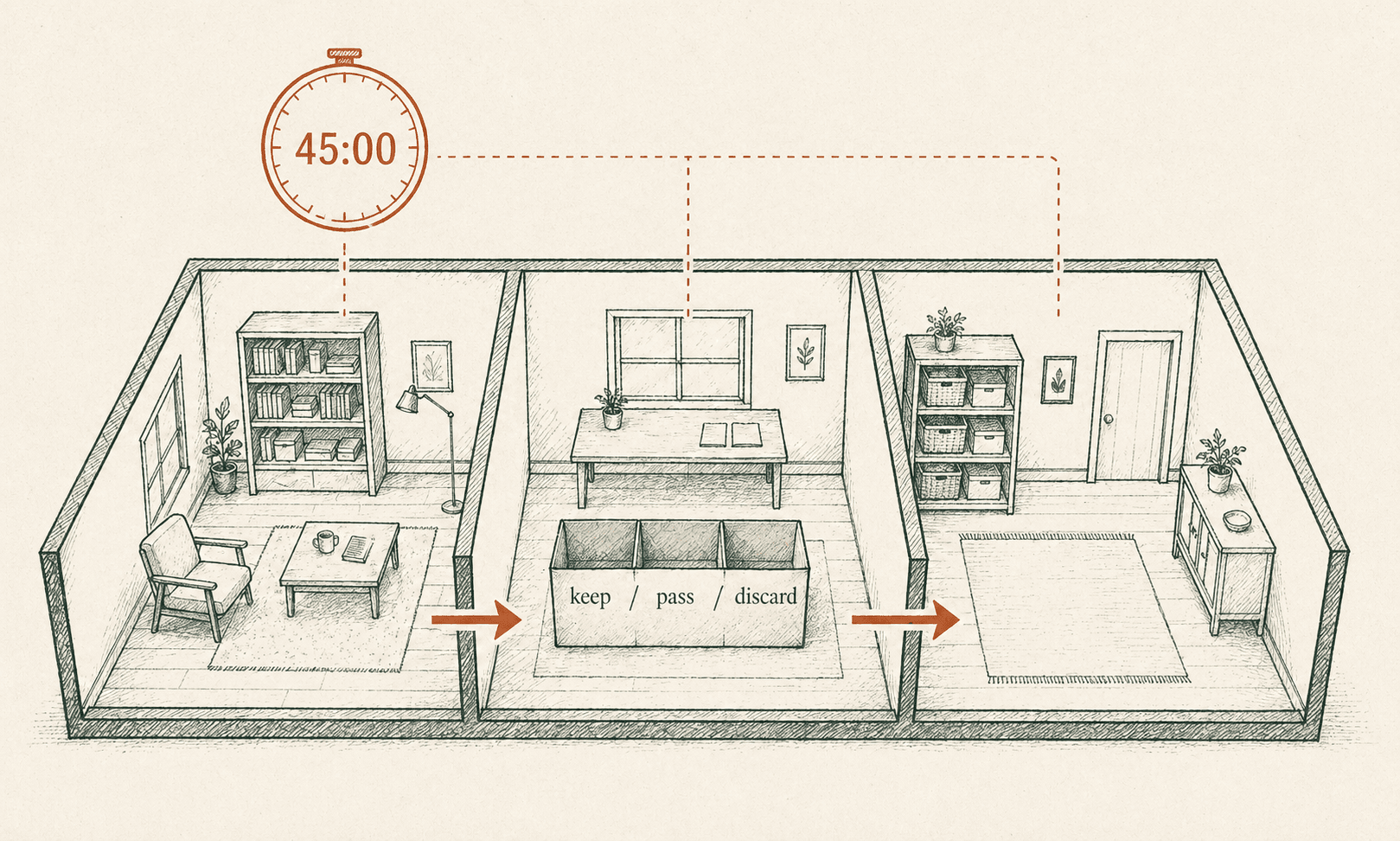
A decluttering methodology built on the underlying logic of Jeff Campbell's Speed Cleaning: the time-boxed, decision-rule-driven, momentum-over-perfection approach that solved cleaning the same way lean manufacturing solved factories. Speed Cleaning works because it removes the friction points that stall most cleaning attempts: open-ended time, decision fatigue, no clear stopping criteria, and perfectionism. Decluttering fails for almost identical reasons. The hypothesis: the same structural logic, applied to a different domain, produces a system most people can actually execute.
The output isn't just a method. It's a method, a kit specification, supporting visuals, and a brand identity. A complete artifact, ready to be tested in the world.
How it was made
The build was a single research-and-synthesis session with ChatGPT. Three moves:
The first move was research. Pull apart Speed Cleaning into its load-bearing principles: time boxes, decision rules, spatial sequencing, the permission to leave imperfect work behind. Understand which of those principles are doing the actual work and which are domain-specific to cleaning.
The second move was domain transfer. Apply the structural principles to decluttering and let the new domain reveal which principles need translation. (Time boxes translate cleanly. Decision rules need rewriting; what makes a kitchen "done" is different from what makes a closet "decluttered.") Iterate the system until it has its own internal logic, not Speed Cleaning's logic with the words swapped.
The third move was packaging. Generate the kit specification, the supporting imagery, the fictional book cover. The packaging exists so the methodology can be tested as a thing, not just a document.
The core insight
Decluttering doesn't fail because people are lazy. It fails because the work is structurally hostile to most people's lives. There's no obvious finish line. Every object asks for a decision. Every decision asks for emotional bandwidth. Most people run out of one or the other before they're done.
Speed Cleaning solved the equivalent problem in cleaning by imposing constraints: a 45-minute session, a fixed sequence, a set of rules that take the decision out of the moment. The work becomes finite. The friction goes down. People actually do it.
Translating that to decluttering produces something most decluttering systems don't: a finishing line. You stop because the timer says so, not because the room is perfect. You move on to the next zone next session, not now. The system gives you permission to leave imperfect work behind, which turns out to be the unlock that makes the work get done at all.
What this demonstrated
The methodology is interesting on its own. The meta-story is the more important part.
A complete, usable, market-ready methodology, with a kit, with imagery, with the shape of a product, was built in a fraction of the time this used to take. Not because AI replaced expertise. The expertise of Jeff Campbell, refined over decades, is the load-bearing layer here. AI made it possible to retrieve that expertise, understand it at the principle level, transfer it across domains, and package the result. No permission asked, no publishing deal, no years of iteration this kind of work usually requires.
The artifact is proof of a new kind of creative reach. It is also a question worth sitting with: what stops more people from doing this in the domains they care about?
The Future Retro move
The thing this project did not do is invent a new system. Speed Cleaning is decades old. Its principles were already validated. The move was retrieval: finding what's worth saving from a proven framework and carrying it forward into a new domain. That's the Future Retro posture: past frameworks as source material, not nostalgia. The interesting question isn't what new thing can we build with AI? It's what existing thing is worth bringing forward, and is now possible to bring forward at almost no cost?
A note on the source
Methods and systems can't be copyrighted. Specific text can. The user guide for Speed Decluttering applies Speed Cleaning principles in original writing; it does not paraphrase or quote Campbell's text. Acknowledgment of the source is in the introduction, both because it's the right thing to do and because the lineage is part of the story.
What's next
The methodology has been built but hasn't yet been pressure-tested in the wild. The natural next move is using it on a real space, documenting what works and what breaks under actual conditions, and revising. The Lab entry continues from there.
If the work holds up under use, the artifact has the shape of something productizable: a workshop, a paid kit, a workbook. That's a parking-lot question. For now this is what it is: a methodology built quickly because the underlying tools made that possible, documented honestly because that's what the Lab is for.