The Whole Life Diet
A plant-forward dietary framework, built in an afternoon and not used for a year.
- Systems
- Health
- Methodology
- Retrievability
Artifacts
- Whole Life Diet Framework (PDF)In progress
What was built
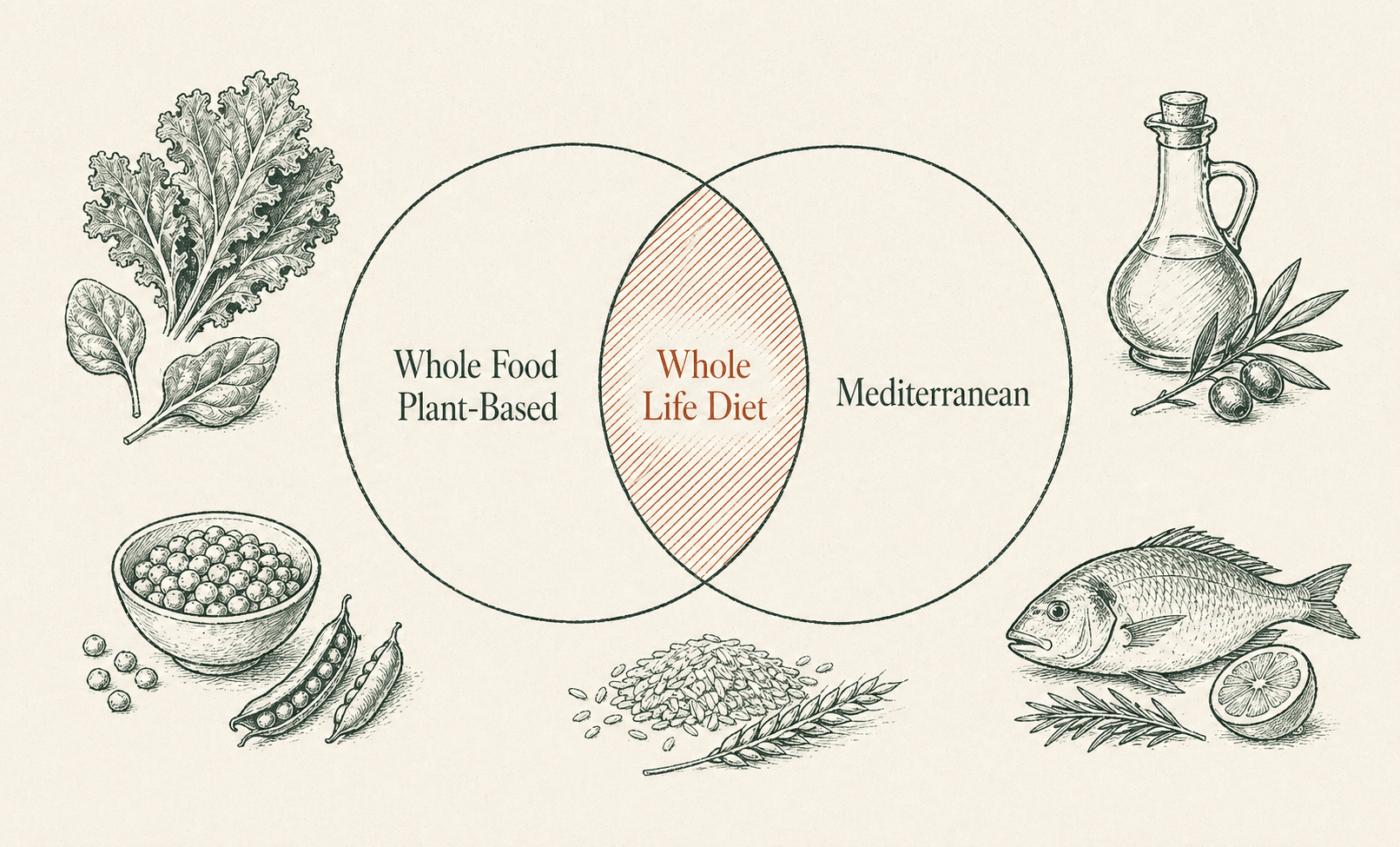
A custom dietary framework, synthesized through AI deep research, that pulls from the best-validated principles of whole food plant-based eating and the Mediterranean diet and combines them into a single coherent system.
The framework is plant-forward but not exclusively plant-based: meat and light dairy in reasonable amounts. It's grounded in nutritional science with strong consensus backing. It's designed to be accessible and sustainable without becoming joyless or ideologically restrictive. And it's generative: it produces a wide variety of meals without constant constraint-checking in the kitchen.
Built once. Used briefly. Then it sat.
How it was made
The work happened in a single deep-research session with ChatGPT. Three passes.
The first pass was source analysis. Pull apart whole food plant-based and Mediterranean dietary frameworks into their underlying nutritional logic: what's actually doing the work, separate from the cultural and philosophical wrappers each tradition carries. Where do the two converge? Where do they diverge in ways that matter? Where are the points of conflict that need a deliberate resolution rather than a fudge?
The second pass was synthesis. Take the convergent core, integrate the strongest elements from each side of the divergence, and produce a framework with its own internal logic. Not a summary. Not a halfway compromise. A new artifact that's more usable than either source alone because it doesn't ask the user to commit to a tradition's worldview before it earns its way into the kitchen.
The third pass was packaging. Generate the framework document, supporting imagery, and a fictional book cover. The packaging matters because it changes what the artifact can do. A framework that looks like a book is a framework someone might actually adopt.
The honest part
I didn't use it.
I built it. I read it. I thought it was good. And then it joined the long list of things created in a chat window that quietly disappeared into chat history and never made it into the kitchen. A year later, I came back to it and noticed that the failure wasn't in the framework. The failure was that the framework had no durable home. It wasn't the kind of thing I could retrieve at the moment of cooking, or check against when planning a week of meals, or share with my wife in a conversation about what we wanted to eat.
This is the meta-story of the Lab entry, and it's a more useful one than a clean success narrative. Most of what people create with AI right now follows the same trajectory: produced quickly, marveled at briefly, lost. The pattern isn't a failure of the tools. It's a failure of the surrounding system: no retrieval, no refinement, no integration into daily decisions.
The retrievability insight
Retrievability is the missing link between AI-assisted creation and adoption.
If a framework lives in a chat history that you can't query and probably can't find six weeks from now, it doesn't matter how good it is. It might as well not exist at the moment you actually need it. What changes the equation is a structured place where AI-assisted artifacts live: a personal knowledge system that AI itself can query and bring back into any future session. The framework becomes available at the moment of decision, not just at the moment of creation.
That's the structural shift this project is, in retrospect, teaching me. The dietary framework isn't the artifact. The dietary framework plus the system that lets me actually use it. That's the artifact.
The Future Retro move
What the synthesis pulled forward isn't the diets themselves. It's the underlying nutritional logic that both traditions had quietly arrived at over decades of research and centuries of practice. The Mediterranean way of eating works for reasons that show up in the data. WFPB works for reasons that show up in the data. The intersection (what both traditions agree on) is more durable than either alone. AI's job here was retrieval and assembly, not invention. That's the Future Retro posture: bring forward what's already proven, drop what doesn't translate, and let the new artifact carry the value forward into a more accessible form.
What's next
A revision is warranted. The framework was built before the personal knowledge system that would make it usable existed. With that system now in place, the natural next move is a refresh: pull the framework into a place where it can actually be queried, run it against current nutritional research, and start using it in real meal-planning conversations. The before-and-after of the PKM-enabled version is the more interesting story.
The Lab entry continues from there. If the framework holds up under use, it eventually graduates from a Lab artifact to something that informs a shared Meal Planning system. For now, the honest framing is: I built something that was good, didn't use it, learned why, and the learning is the durable result.