How to Build Your Personal AI Standard of Use Framework
- AI
- Frameworks
- Personal Systems
The conversation about AI keeps getting framed as a binary: you're either all in, automating everything in sight, or you're resistant, skeptical of the whole thing. Most of us live somewhere in between — and that's actually the harder place to be, because "somewhere in between" without intention tends to drift.
If AI is here to stay (and it is), then at some point the question stops being whether to engage with it and starts being how. Organizations figured this out quickly — many are already writing acceptable use policies for employees, because the brand, legal, and ethical stakes are real. What strikes me is that individuals rarely think about it the same way. We probably should.
So I built mine. What follows is a two-track framework: a manual version you can work through yourself in about 30 minutes (I did this last week — it was more eye-opening than I expected, and it made me think about my relationship to technology broadly, not just AI), and an AI-assisted version that can take you somewhere surprisingly deep with a single prompt. This is V0.1. It'll evolve. But something is better than nothing, and nothing is exactly what most of us have right now.
The case for a framework, not a rulebook
Rules are brittle. "I will never use AI to write emails" sounds principled until the week you're managing a family emergency and your inbox is drowning. A framework is different — values and honest self-assessment that guide decisions without locking you in. It adapts as your situation changes, as you change.
The goal isn't purity. It's intentionality.
What goes into one
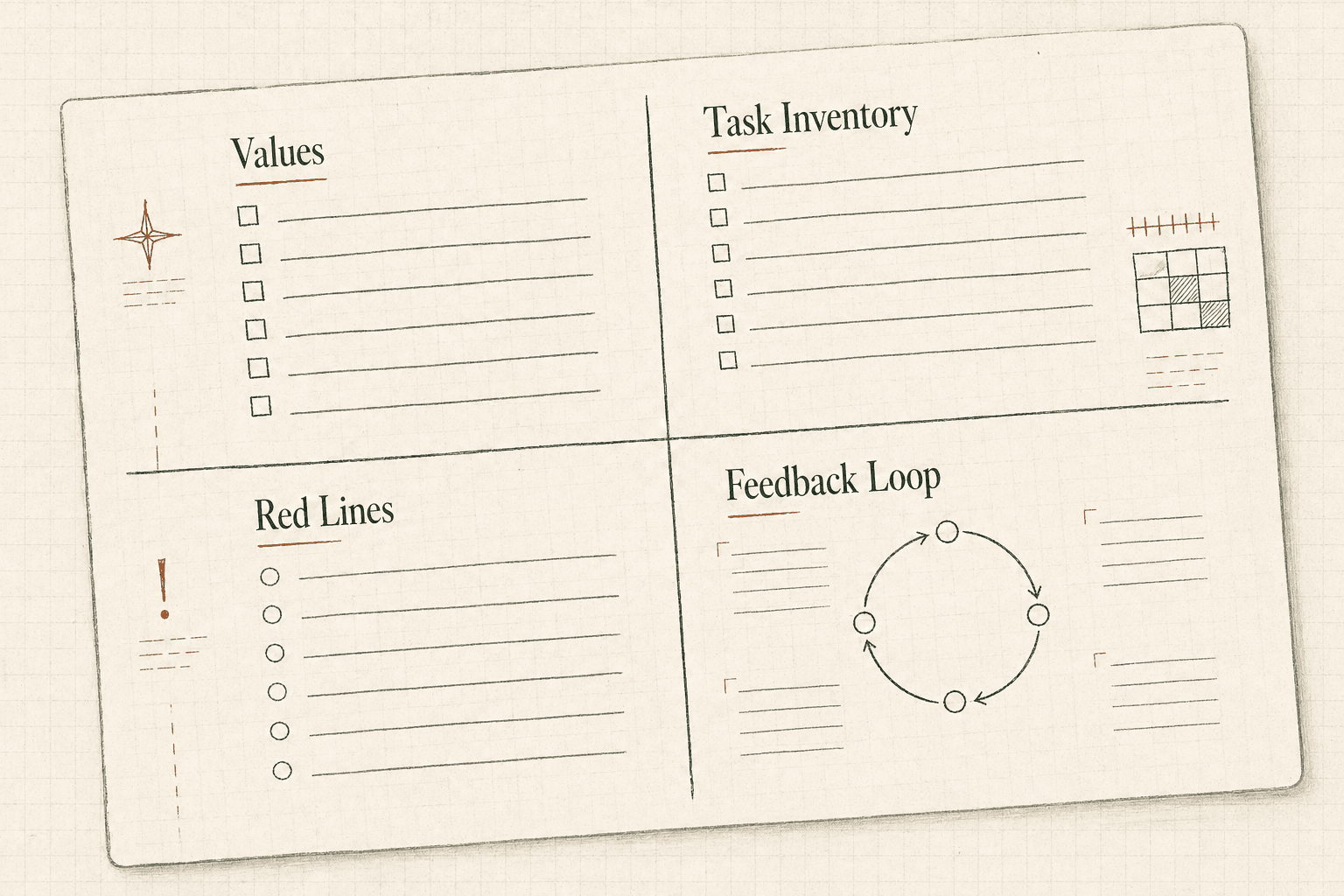
Four things: what you're protecting, an honest map of how you actually work, where you won't go, and a way to notice when you've drifted. Together they give you something you can actually return to — not just intentions, but a document.
Start with your values anchor. What do you want AI to protect? Focus, creativity, your relationships, your sense of ownership over your work? This isn't an abstract exercise — it determines every other decision in the framework.
From there, build a task inventory. Most people find this more useful than they expect. Not all work is equal: some is repetitive and low-stakes, some is irreplaceable. The judgment calls, the original thinking, the moments where being fully present matters. You're mapping your work honestly across that spectrum — probably for the first time.
Then name your red lines. Where won't you use AI, even when it's convenient? Not because AI is bad there, but because doing it yourself matters — for skill, for authenticity, for how it makes you feel. Name them before you drift past them.
Finally, build in a feedback loop. A framework without review drifts; that's just how it works. Pick a trigger — every Sunday evening, every month-end — and ask yourself one question: is my AI use serving what I said I wanted to protect? Five minutes. That's the whole thing.
Track 1 — work through it yourself
Budget about 30 minutes and something to write with.
Step 1. Write down three to five things that matter most in your work and life — not goals, qualities. Focus. Originality. Presence with people. Ownership of your thinking. These are your anchors; everything else in the framework runs through them.
Step 2. List your recurring work tasks and life admin. For each one, ask: does doing this myself make me sharper, or produce something more distinctly mine? And honestly — is this something I'd rather not spend mental energy on? You're not making judgments yet, just mapping.
Step 3. Finish this sentence for at least three areas: "I will handle [this] myself because ___." No justification needed to anyone but you. Just be honest.
Step 4. Pick a simple review trigger and one question. That's it. "Did my AI use serve my values this week, or drift past them?" Sunday evening. Five minutes. Done.
Track 2 — use AI to go deeper
Do Track 1 first if you can. Not as a formality — because working through the questions yourself means AI is sharpening what you've already started rather than generating something you'll adopt without really owning. In matters of personal importance, engage yourself before reaching for a tool.
That said, Track 2 gets you somewhere Track 1 alone probably won't. The task inventory becomes more granular. The policy gets structured. You end up with a more thorough position than most people reach on their own.
Start with this prompt — it may be all you need:
I want to build a personal framework for how I use AI. Start by asking me three questions to help me identify what I most want to protect in my work and daily life.
Follow where it goes. If the conversation flows naturally from there, stay in it. If you want more structure, these three prompts help you go further:
On your task inventory: "Based on my answers, help me map my recurring tasks into two buckets: work that's high-value and irreplaceable for me personally, and work that's routine enough that AI assistance makes sense."
On your red lines: "Now help me write three to five 'red lines' — specific areas where I want to commit to doing the work myself, even when AI could help."
On building the feedback loop: "Finally, suggest a simple weekly or monthly check-in question — just one — that I can use to make sure my AI use is staying aligned with the values we identified."
Treat what you produce as V0.1
Don't wait for it to feel complete. The value isn't a polished document — it's having crystallized how you will and won't use AI. That clarity is the output.
Put it somewhere you'll see it again. Your notes app, your weekly review, wherever you do regular reflection. You'll notice things that want clarifying. You'll update it as AI evolves. A framework that lives in a drawer isn't a framework — it's a writing exercise.