The Tom House Clinic
Right information at the right time transforms potential.
- AI
- Feedback
- Coaching
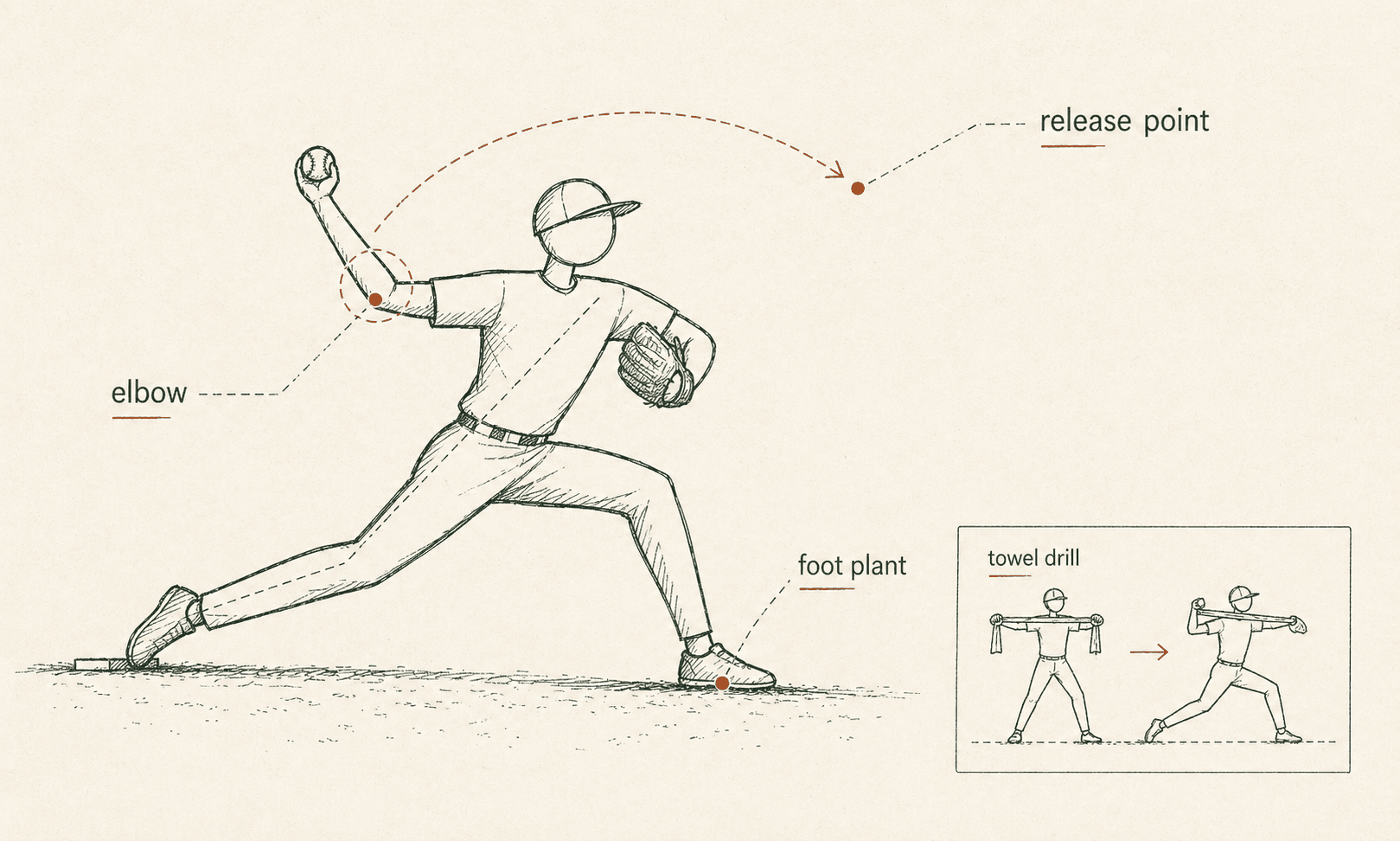
Junior year of high school, I had a great arm and a losing record. I walked too many batters. My elbow hurt. My dad found a coaching clinic in Charleston led by Tom House, Nolan Ryan's pitching coach and, even then, one of the most rigorous sports scientists in the game. Two hours in a group session, fifteen minutes one-on-one, one drill to take home. By senior year I was one of the state leaders in strikeouts. The transformation wasn't about effort. It was about the right information at the right time from someone who could actually see the problem, and that's the part of the story that's stayed with me for thirty years.
What actually made it work
I've replayed that fifteen-minute conversation more times than I can count, and the thing that strikes me now isn't what Tom House said. It's the structure of what happened.
Three things, in sequence. First, expert diagnosis, not generic advice. Tom didn't tell me to throw more strikes or work on my mental game. He looked at my mechanics for a few minutes and named the specific invisible error that was producing all the visible problems. Second, a targeted correction. Not a training plan, not a regimen. Just the thing to fix. Third, a feedback loop I could run alone. The towel drill: a few minutes a day, no coach required, a way to monitor my own form and notice when I drifted. Not motivation. Not effort. Mechanics, correction, feedback.
That's the model. It's an unusually compact one. Most coaching advice gives you maybe two of those three; the third is what makes it stick.
The story is about feedback, not baseball
You can plateau or struggle in almost anything for the same reason I was walking batters: an invisible mechanical error that nobody around you can see, and that you can't see in yourself because you're too close to the work. That's true in writing. It's true in management. It's true in sales calls and parenting and creative practice. Effort doesn't fix it because effort isn't the problem. The system underneath the work needs a correction you can't make alone.
For most of human history, this is exactly the kind of problem that took experts decades to solve and money or luck to access. My dad happened to find a clinic three hours from our house. Millions of kids with the same arm I had never got that. The bottleneck was access to the right expert at the right moment.
What happened when the bottleneck moved
The technology to give almost anyone something close to that fifteen-minute conversation has quietly arrived, and most people haven't noticed.
Film your throwing motion on your phone. Drop it into a model that's read every pitching coach's published work and watched thousands of hours of mechanics. Ask it what it sees. Or, same shape and different domain: record your last difficult conversation and ask what landed and what didn't. Paste in the draft you've been struggling with for two weeks and ask which paragraph isn't doing the work the others are doing. The mechanics are different in each case. The structure is identical: diagnosis, correction, a feedback loop you can run on your own.
I'm not saying the model is Tom House. It isn't. Tom House had decades of pattern recognition built on the bodies of professional athletes, and the relationship between him and a struggling junior pitcher had a quality that no software replicates. What's available now isn't the expertise itself. It's the quality of feedback that expertise produces. Democratized, on demand, in your pocket.
The comprehension gap
Here's what I find strange. The tools are sitting in plain sight. The cost is essentially zero. And almost nobody is doing this.
The reason isn't access. It's imagination. Most of us were trained to think of expert feedback as something that requires a person physically present, a calendar, a fee, and probably a referral. The mental model is "find the right coach." It hasn't yet shifted to "ask better questions of the tools I already have." That's the gap this piece is really about.
The Tom House model still works. We've just stopped recognizing it when it shows up in a chat window.
What to try
Pick one thing you've plateaued on where the honest answer is I don't know what I'm doing wrong. Not a goal you haven't pursued. A place where you've been trying and the result keeps disappointing you. Then run the Tom House sequence on it.
Get a precise diagnosis: not a checklist of generic advice, but a model that watches what you actually do and names what's off. Take one targeted correction, not a five-point improvement plan. Build the feedback loop you can run yourself: a way to check the correction is sticking without needing the coach in the room.
Most of what comes back will be useful. Some of it will be wrong. The discipline is the same as it was in 1995 in Charleston: trust the diagnosis enough to try the drill, then watch what happens.
The arm was always there. What I needed was someone who could see the problem and a way to keep checking my own form. That's not a story about baseball. It's a story about what becomes possible when the right feedback finally shows up, and what it means now that, for almost any kind of work, it has.